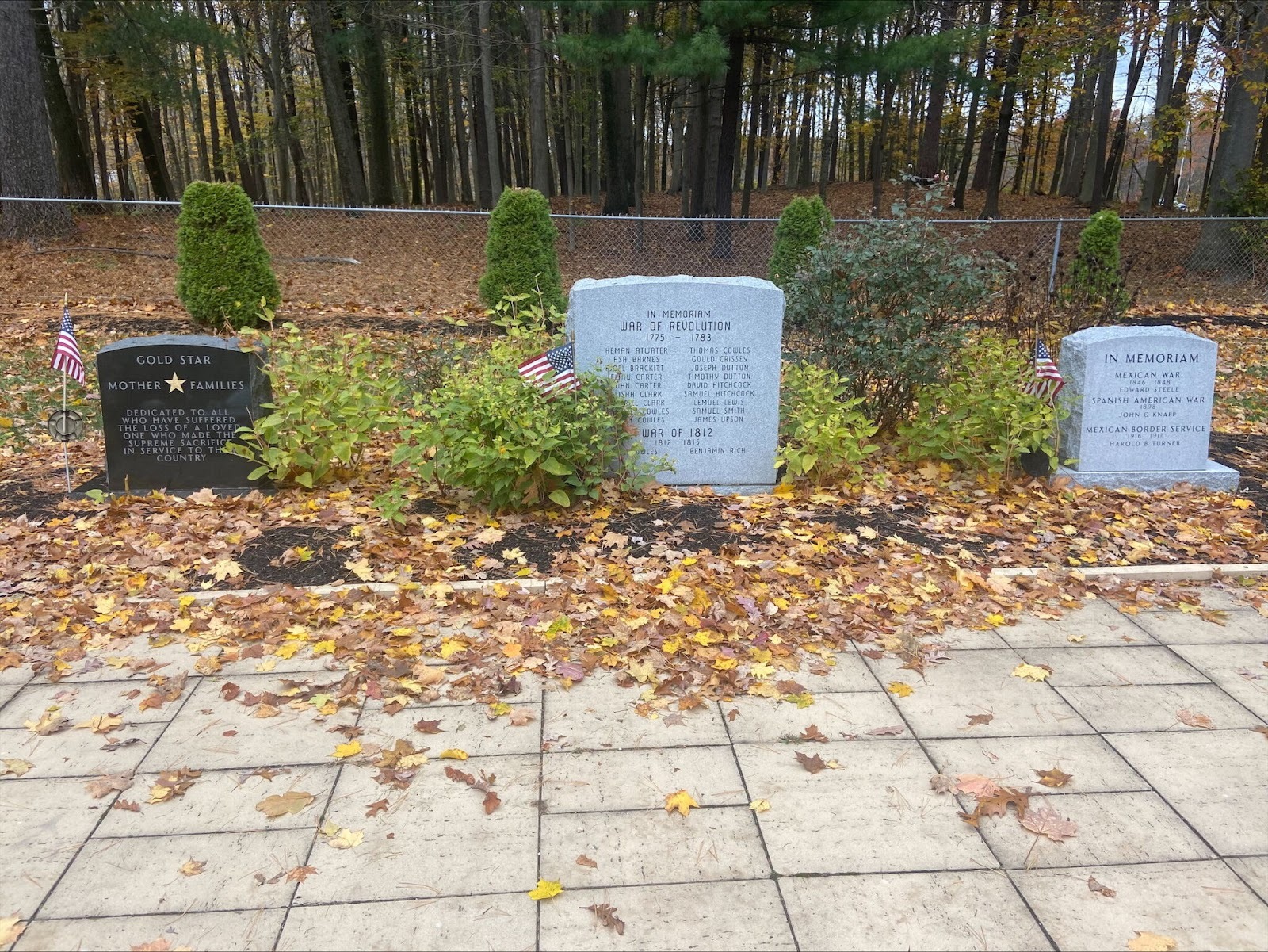
When the gravestones of several Revolutionary War veterans buried in Quinnipiac Cemetery in Southington began deteriorating, Philip Wooding knew he had to do something.
As the president of the Quinnipiac Cemetery Association and the Southington Historical Society, Wooding felt a sense of responsibility to record the information on the centuries-old gravestones.
“Based on the fact that we had lost so many stones, that you probably wouldn’t see a [veteran] with a veteran marker or flag. So he would be, in effect, lost,” said Wooding.
Stones of Revolutionary War soldiers and veterans had previously shown a star or other symbol, but when they began to crumble the markers began to fade.
Initial efforts to restore the stones failed when the proper funding through the association was not ready in time.
“By the time we accrued enough in an endowment fund to do this kind of thing, it was too late for the majority of the stones,” said Wooding.
Not willing to give up on memorializing the soldiers, Wooding looked through Historical Society archives for more information to have a permanent memorial installed.
The research had already been done. His late uncle had been the first to notice stones from the 1700s and 1800s were becoming weathered.
“He was active, very active in the cemetery, and very much interested and involved in perpetuating the service of men from the very early conflicts,” said Wooding.
Using information his uncle had pulled from state archives, Wooding discovered 18 men buried in Quinnipiac Cemetery who had served in the Revolutionary War. He also found the names of two additional men who had served in the War of 1812. The Historical Society archives lists their birth and death dates, as well as their dates of service.
The gravestones of all 20 men were in varying states of deterioration, so Wooding had a permanent collective memorial stone installed.
The Revolutionary War soldiers memorialized are Heman Atwater, Asa Barnes, Joel Brackitt, Elihu Carter, John Carter, Elisha Clark, Ithuriel Clark, Gamaliel Cowels, Josiah Cowels, Thomas Cowles, Gould Chrissey, Joseph Dutton, Timothy Dutton, David Hitchcock, Samuel Hitchcock, Lemuel Lewis, Samuel Smith, and James Upson.
The War of 1812 soldiers memorialized are Ashbel Cowels and Benjamin H. Rich.
Among the names on the stone are some that were previously familiar to Wooding. Many hailed from notable Southington families that had founded the town or were instrumental in its development, he said.
“Most of these names are recognizable from town. You have a Barnes, you have an Atwater, you have Clarks, you have Cowles,” said Wooding. “So these are local names.”
Christina Volpe is the curator of the Barnes Museum, a Southington museum dedicated to preserving the memory of the town’s history through properties belonging to the Barnes family.
Asa Barnes is one of the names on the stone erected by Wooding and is connected to the Revolutionary War through his association with French General Jean-Baptiste de Rochambeau.
“Asa Barnes, when the French encamped here in the 1780s, he did own the tavern there. [He] became pretty good friends with Rochambeau, to the extent in which Rochambeau, on his march back, came back to visit Asa Barnes at the tavern,” said Volpe.
By Avery Martin, a journalism student at Southern Connecticut State University, reported this story in 2025 as part of Journalism Capstone coursework on the Revolutionary War.