By Jay’Mi Vazquez, SCSU Journalism student
In 1777, during the American Revolutionary War, approximately 200 Continental Army prisoners suffering from smallpox were abandoned by the British near Milford, Connecticut.
According to Milford City Historian Arthur Stowe, the British ship had been tasked with transporting the prisoners from New York to Milford.
“I don’t know why they chose Milford to transport these POWs, dump them off the ship and say, boys, you’re free to go home, but cross your heart, you’re not going to fight us anymore,” Stowe said.
The trip, expected to take only a few days, stretched to ten due to severe weather. Many prisoners, already infected with smallpox, died along the way.
“We remember what it was like with COVID and lockdowns,” Stowe said, emphasizing the disease’s severity.
When the ship finally reached Milford, it offloaded the men on a “miserable, rainy, snowy, freezing, cold day and night,” Stowe said.
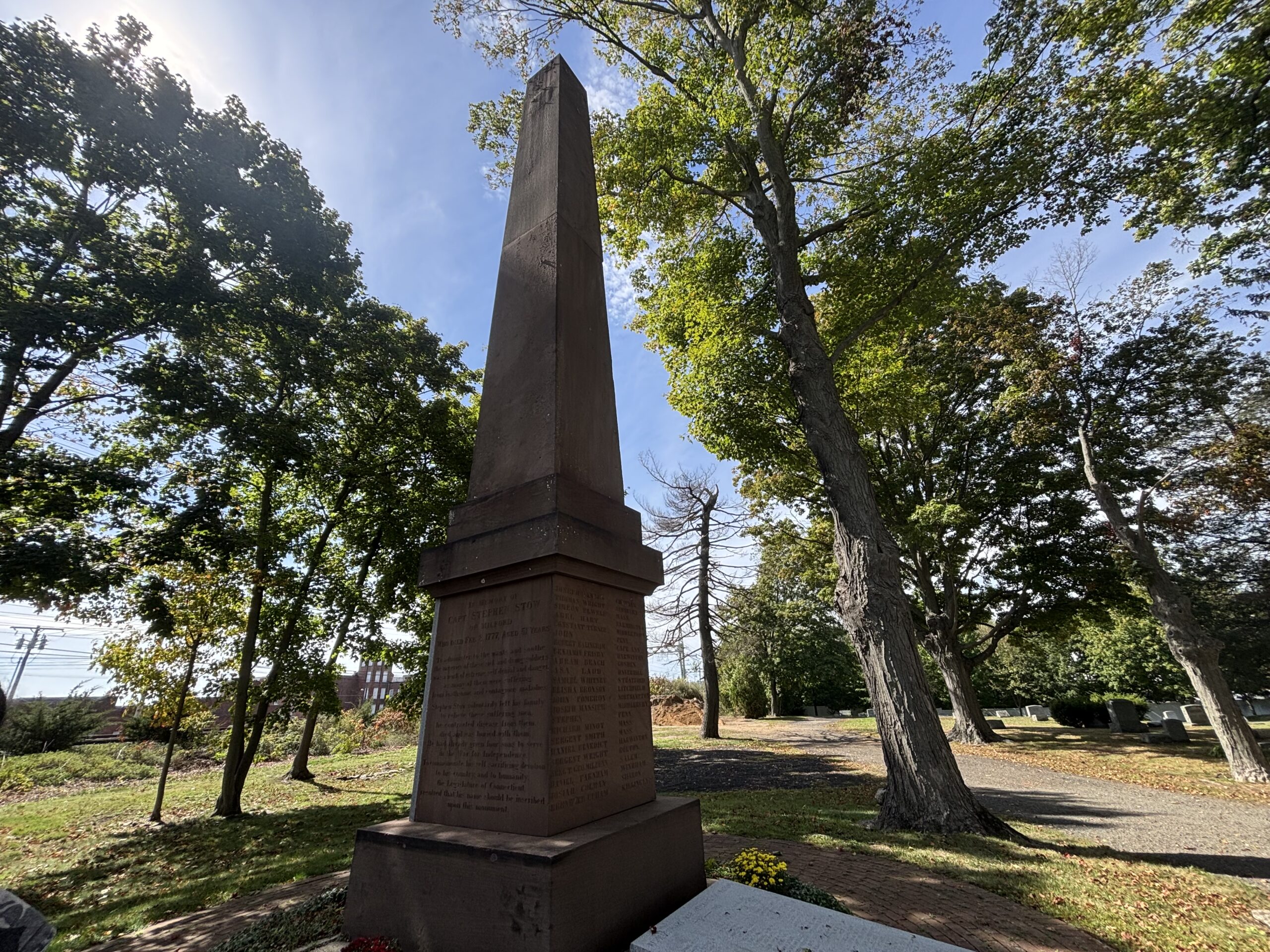
A local farmer found the abandoned prisoners, and town leaders resolved to care for them. Dr. Elias Carrington provided medical aid, and Captain Stephen Stow, a Milford resident, volunteered to nurse the sick. He contracted smallpox and died on Feb. 8, 1777. Forty-six prisoners also perished that month.
In 1852, the Connecticut General Assembly and Milford residents honored these men and Stow’s sacrifice with the Soldiers’ Monument, a sandstone obelisk in King’s Highway Cemetery.
According to a January 2025 press release from the Milford City Clerk, the city’s legacy of preservation continues through the efforts of City Clerk Pete Smith and Stowe. Working with the Milford Historical Society, they are digitizingand sharing Milford’s extensive collection of historic documents.
With the nation’s 250th anniversary approaching, many of these materials are now being made available to the public through the online archive titled “History from the Vault.”
For Stowe, a descendant of Captain Stephen Stow, the work carries personal meaning. It links the courage and compassion shown by his ancestor during the Revolutionary War to the city’s modern efforts to preserve and share its history with future generations.
Jay’Mi Vazquez, a journalism student at Southern Connecticut State University, reported this story in 2025 as part of Journalism Capstone coursework on the Revolutionary War.